
So far, I’ve been putting out pieces about matters related to what’s happening in the football world at that particular point of time. So why not take a step back? Why don’t we take a look at people/events that shaped the Beautiful Game into what it is today?
Ever since the inception of the Beautiful Game, and the evolution of football tactics, dating back to the late 19th century, the game has slowly evolved. As the decades go by, football has slowly turned into a battle of wits, as much as physicality and skill. As the years go by, players and managers alike engineer new methods in order to gain the upper advantage over their opponents. A culmination of all those ideas executed by those pioneers of football result in the metaphorical poetry in motion we view in the digital age.
Before we go any further, let me state that there is no perfect formation in football. The sport is still evolving, despite the notion that the game has reached a state of perfection. Throughout the decades, there have been many events/people/methods that have changed the game. Take legendary Arsenal manager Herbert Chapman’s WM formation in the 1930s, which he executed in order to adapt more to the offside rule. Italy’s Catenaccio, which adhered to their defensive style, which put an extra sweeper behind the back four, as a sort of insurance policy to keep players out, while the back four had man-marking duties. Or Hungary’s positioning, which revolutionized modern football, allowing attackers to run into space instead of directly at their opponents.
Being a Manchester United supporter, I obviously prefer all-out, full fledged counter-attacking football. But then again, which of us in the modern era doesn’t? I absolutely love passing. If you ask me, I’d rather pass the ball to my teammate running in behind, or run opponents around in circles with a flurry of one touch passes instead of trying to beat my man by running at him and hoping for the best. Which brings me to the topic at hand. If you ask me, the one tactic that embodies the spirit of the Beautiful Game in the 21st century, is none other than the style perfected by Rinus Michels, known as Total Football. This will forever be a gilded term in the football lexicon.
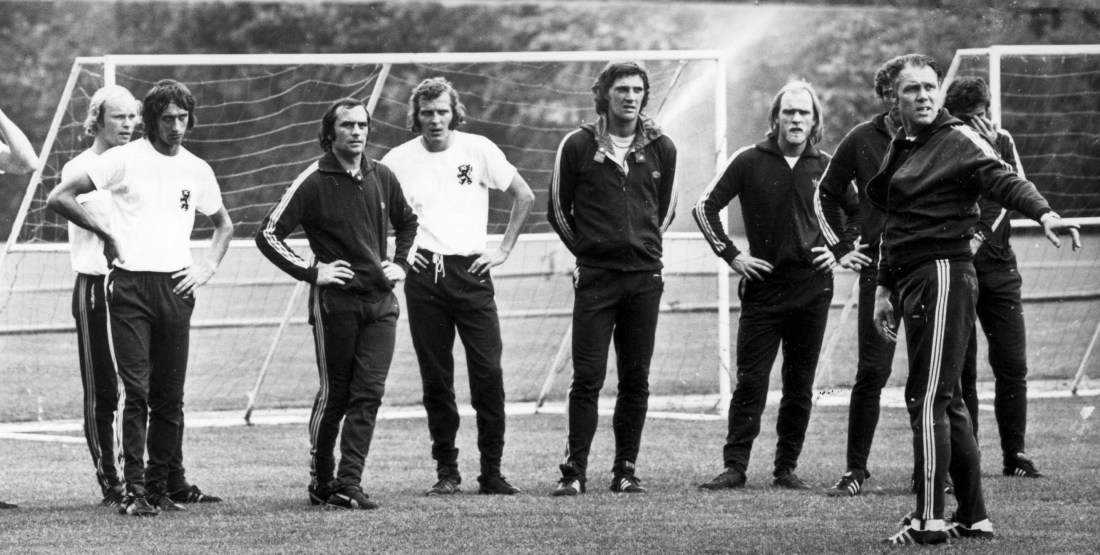
The reason I say ‘perfected’ instead of ‘created’ is because this style of football existed, albeit in patches, before Michels unleashed his football revolution at Ajax Amsterdam in the 1960s and 1970s. But it wasn’t perfected. Rinus Michels viewed football in his own way. If you gave it a word, it’d be Maakbarheid – the ability and willingness to shape, mould, and control an entire physical environment and all that occurs within that environment. This required a strong, determined mentality and intelligent application. Granted, football was not as primitive as you might think during that time. Full backs overlapping wingers and strikers dropping back to collect the ball – these existed even before Michels introduced himself as a force to be reckoned with.
Before Michels, there had been exploits and moments of beautiful, intelligent football played out, examples of which I’ve already stated. But Michels was different. For his style of play to work, he needed space. Total oscillation. David Winner, in his excellently written book, Brilliant Orange: The Neurotic Genius of Dutch Soccer, touches on this very notion:
“Total Football was, among other things, a conceptual revolution based on the idea that the size of any football field was flexible and could be altered by a team playing on it. In possession, Ajax – and later the Dutch national team – aimed to make the pitch as large as possible, spreading play to the wings and seeing every run and movement as a way to increase and exploit the available space. When they lost the ball, the same thinking and techniques were used to destroy the space of their opponents.”
Michels, himself a former Ajax player, received a similar education under the guidance of British managers Jack Reynolds and Vic Buckingham, which helped instill the nature of Dutch football, which would later help create a style that would change the game forever.
From his appointment as Ajax manager in 1965, he began to reshape the club’s philosophy into his own, that would later branch out all across the world. Total Football required technically sound players to constantly be on the move, keeping possession, passing the ball around, occupying spaces left by teammates. Michels’ Ajax, Barcelona and Netherlands teams all followed this system. This made it extremely difficult for the opposition players to keep track of a player. Footballers were expected to be capable of playing in defence, midfield and attack, creating an incredibly universal side. Every player, goalkeeper included, was involved in the buildup of an attack, interchanging positions constantly, which dragged opponents out of shape, allowing them to move forward, applying more pressure. It was beautiful. Ruthless. Swift. Intelligent. Groundbreaking. It was poetry in motion.
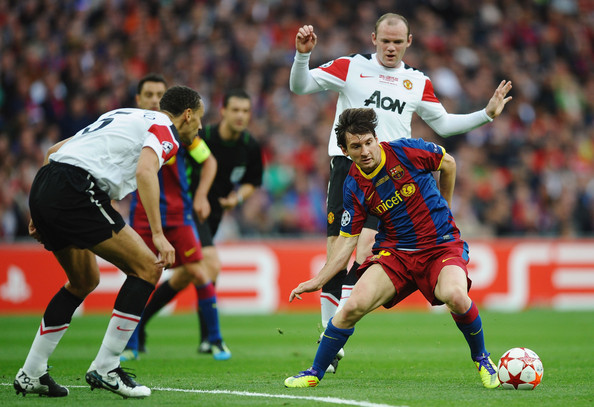
This was where the concept of a ‘False 9’ was created, unlike people’s perceptions that it originated during Pep Guardiola’s tenure at Barcelona. A False 9 is a roaming forward who has the freedom to move anywhere on the pitch in order to initiate attacks and break opposition defences. Pep Guardiola allotted this position to the superhuman Lionel Messi, which yielded scintillating results.
The football Michels required from his players was of the intelligent, positive, attacking variety. His teams at Ajax, Barcelona and most notably, the Netherlands national team (the Oranje) were able to showcase a machine-like efficiency as a unit, while at the same time bring out the individual brilliance of each player. Michels turned football into an art form, and his players, Johan Neeskens, Johan Cruyff, Pat Keizer; and later under Cruyff, Ronald Koeman, Ruud Gullit, Marco van Basten, Frank Rijkaard and Jan Wouters were handed the paintbrushes. Here’s an example of Total Football, showcased brilliantly by Netherlands in 1988.
Out of all the teams Michels managed, it was the Oranje team of 1974 that showed us the true nature of Total Football. They effectively brought an end to the Brazilian juggernaut by beating them 2-0 at the 1974 World Cup, in humiliating fashion.
Perhaps the one player in all of Rinus Michels’ teams that embodied everything stated out in his philosophy was Johan Cruyff. One of the greatest players to ever kick a ball, and possibly the most influential person the sport has ever had. With him as a deep-lying forward, he would create chances for his teammates, get into space, or just dazzle us with some impossible piece of skill.
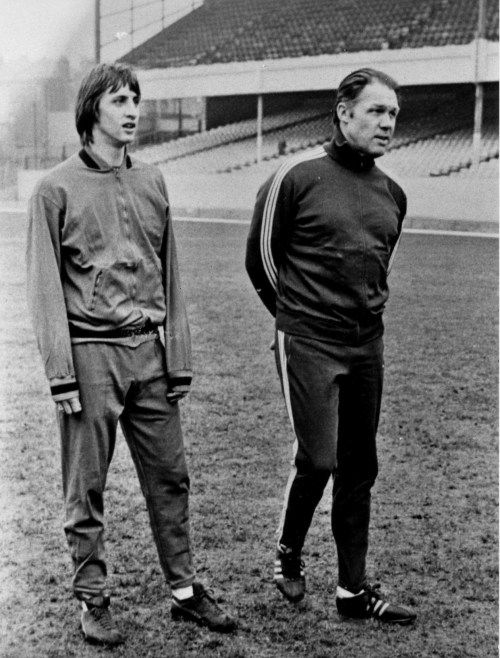
Cruyff continued Michels’ philosophy (with his own tiny modifications), passed it on to younger generations of Ajax players, creating football juggernauts like RuudGullit, Frank Rijkaard and Marco van Basten. He later passed it on to FC Barcelona, effectively making their philosophy his own, and in extension, Michels’. Using Total Football, he created his Dream Team in the early 1990s, comprising of players like Romario, Michael Laudrup, HristoStoichkov, Ronald Koeman, Pep Guardiola and so on. Johan Cruyff is also credited with the idea of La Masia, which we know today as Barcelona’s youth setup, which has produced players like CarlesPuyol, Gerard Pique, CescFabregas, Sergio Busquets, Xavi, Andres Iniesta, and most notably, Lionel Messi.
Even today, Barcelona follows the philosophy introduced to them by Johan Cruyff, whose protegé, Pep Guardiola passed it on to his Barcelona team of 2009 and the early 2010s, the style we call Tiki Taka, forming possibly the greatest football team of all time. Pep now manages Manchester City, where he still employs his mentor’s methods, which seem to never fail to destroy the opposition, which is the stuff that feeds our football obsession through a slow IV drip into our collective bloodstream, no matter which team we support.
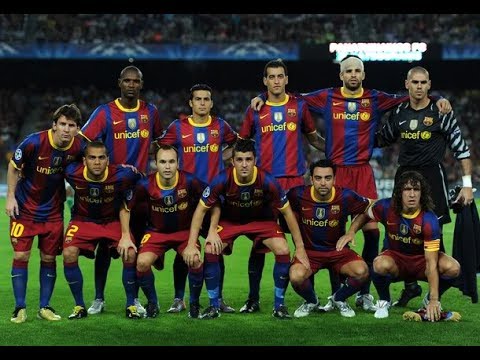
Total Football is still alive in its many forms, and has brought a considerable amount of success for the teams which employ them. The ideas put forth by Rinus Michels, Johan Cruyff and their respective protegés will never be forgotten, as they continue to smite us. By doing away with the idea of ‘fixed’ positions and rigid formations, football found new identity. The gelatinous formations and the fluid style of football gave way to a game of constant movement and circulation. A game of space. And that, my friends, is Total Football.
Thank you for reading. I’ll be back with more content.
Sarma out.

 My Obsession with the Beautiful Game - An Analysis of Football By a Bored Teen