
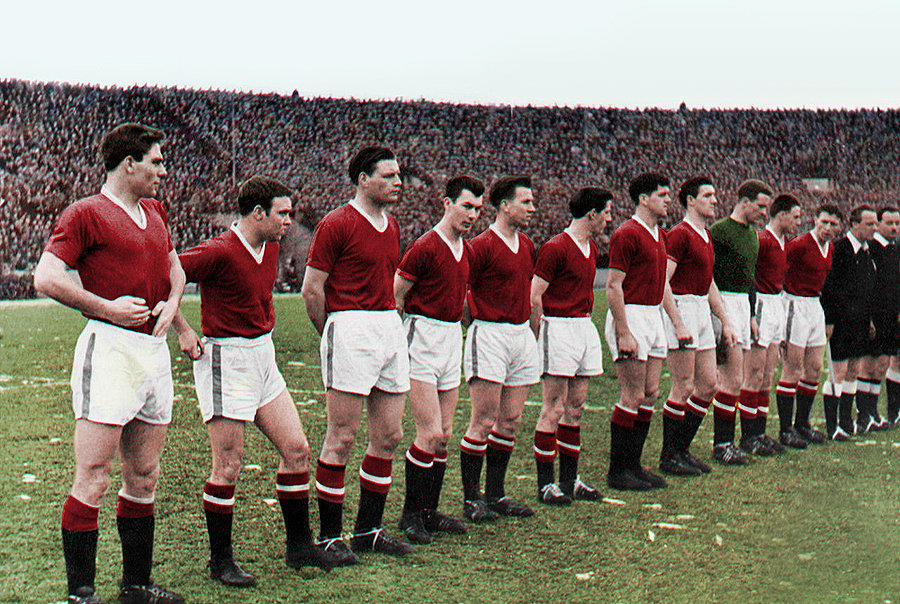
Manchester United are known for their never-say-die spirit. Fighting against the very end no matter how stacked the odds are against them. We’ve seen countless games where they’ve been outplayed, outscored or outshone, but they’ve managed to fight back and snatch victory from the jaws of defeat at the very death. Off the top of my head, I’d cite the famous 1999 Champions League final win after two goals in injury time to steal the title away from Bayern Munich. Or *that* Michael Owen goal in the dying seconds of the Manchester Derby in 2009 at Old Trafford. But I’m not about to give you a history lesson on all the famous comebacks Manchester United have made in their 140 year history (Trust me, that’ll take a looooooooong time to list out).
England’s most successful club have had countless moments and events in history that will go down in football lore as some of the most memorable in history. But none will be more important than the tragedy that occurred on February 6th, 1958. British European Airways Flight 609 crashed on it’s third attempt to take off from a slush-covered runway at Munich-Riem Airport. 44 passengers, including the Manchester United squad, manager Matt Busby, supporters and journalists. 20 of the 44 died at the scene of the crash. 3 more were rushed to Rechts der Isar Hospital in Munich, where a further two died from injuries sustained. Shock waves spread throughout Britain and the football world. The club would never be the same again. There was no way the club could survive and get past such a horrible tragedy. But, as ever, Manchester United would make probably the greatest comeback in their history. But I’m getting ahead of myself. This article isn’t about the tragedy itself, but about the club and it’s squad of potential European heavyweights prior to the crash.
‘The Busby Babes’, a term coined by Manchester Evening News journalist Tom Jackson, was given to a group of footballers recruited and trained by Manchester United through their academy by chief scout Joe Armstrong and assistant manager Jimmy Murphy. They were promoted to the first team by the late, great Sir Matt Busby. At that point of time, managing a club like Manchester United and taking them to such great heights was the equivalent of scaling Mount Everest. The club was relegated twice in the 1930s and were close to bankruptcy. To make matters worse, their home ground, Old Trafford, was bombed by the Luftwaffe, leaving them to play their home games in Maine Road, home to local rivals Manchester City.
As soon as Matt Busby took charge in 1945, he saw a vision. He saw a future. He saw beauty in that old bombed stadium. He saw an opportunity to create a phoenix out of the ashes of that stadium. He would change the philosophy and ideology of the club for decades to come. A philosophy United still follow to this day (minus Mourinho’s bus parking). He wanted newer, fresher legs, players he could mould and develop in his own image. He knew that the youth had the key to success, not just for United, but for the future of the game. He won his first title within two years of his reign. But his team was ageing. It was time for the youth to take charge.
Soon, players like Roger Byrne, Jackie Blanchflower, Mark Jones, Eddie Colman and Duncan Edwards became first team regulars. Soon, the titles started to flow, as United ran away with the League title in 1956. The average age of the squad players was 22. Babes indeed. Busby started to set his sights on greater things. The newly formed European Cup was one of those things. United soon started to make their mark in Europe. Their biggest win came in the preliminary round of the 1956-’57 edition, with a 10-0 demolition of Anderlecht, a result which still remains United’s biggest win in a competitive match. Wins against Borussia Dortmund and Athletic Bilbao took them to the semi-finals, where they lost to the legendary Real Madrid side 5-3 on aggregate, a side consisting of all time greats like Alfredo di Stefano, Francisco Gento, Raymond Kopa and the like.
United were still marching on, with young players being promoted from the youth team. One player in particular was a young Englishman named Bobby Charlton. United retained their league title, making significant additions to the team, like goalkeeper Harry Gregg. Matt Busby and United soon focused on winning a third consecutive League title, and planning another assault on Europe. The season went by smoothly as expected, both domestically and in Europe. The first match in February 1958 saw United beat Arsenal in a 5-4 thriller, which left them in high spirits for the European Cup quarter-final second leg trip, where they would meet Red Star Belgrade………
Sadly, they never got to play.
Of the 23 that perished, Geoff Bent, Roger Byrne, Eddie Colman, Mark Jones, David Pegg, Billy Whelan and Tommy Taylor from the first team perished. Club secretary Walter Crickmer, trainer Tom Curry, and chief coach Bert Whalley from the staff also perished along with supporters and journalists. Duncan Edwards was found alive, and was rushed to the hospital, where he died 15 days later from injuries sustained. Duncan Edwards is remembered among United fans in particular. Had he survived, he would probably have been the one to lift England’s 1966 World Cup instead of Bobby Moore. Had he played on, we would have spoken about him in the same breath as Pele, Garrincha, di Stefano, Best and Cruyff. But alas, it was not to be.
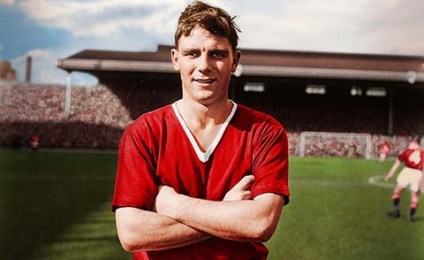
“United can’t possibly bounce back after this.” This was the thought that went through everyone’s head. Matt Busby was forced to stay in hospital for a further few months, while Jimmy Murphy, his assistant stood in as manager, having not traveled with the squad. A team largely composed of youth and reserve team players beat Sheffield Wednesday 3-0 in the first match after the disaster. It was a tragic time for the club. But Matt Busby had no plans of giving in. After resuming managerial duties in the 1958-’59 season, he set out to create a new generation of Babes. Ten years after that tragic crash, Matt Busby’s Manchester United, spearheaded by crash survivor Bobby Charlton, along with George Best and Denis Law (The Holy Trinity), beat Benfica in the finals of the European Cup, and took them to the pinnacle of European football. Bobby Charlton and Bill Foulkes were the only two crash survivors to line up in that game.
Bobby Charlton went on to form one of the best attacking trios of all time, with George Best and Denis Law. He won the 1966 World Cup with England, and the Ballon D’Or in the same year. He went on to become Manchester United’s and England’s all-time leading goalscorer before leaving in 1975. His goal scoring records stood for almost 4 decades, before he was surpassed by Wayne Rooney, for both club and country. Matt Busby managed United till 1969, before returning for a short stint from 1970 to 1971, winning 13 trophies overall, and leaving as one of the greatest managers of all time.
The events that occurred in Munich still remain deeply rooted in every Manchester United fan’s heart. Manchester United would not be the club it is today if not for what happened. In the midst of all the mourning and bereavement, the club and it’s supporters found a new sense of identity. A never-say-die attitude. To keep fighting till the very end. Those values still resonate within Old Trafford. 60 years on, the tragedy of Munich is still fresh in the memory of football fans. It also serves as a lesson to all of us. Never back down in the face of adversity. Keep fighting till the very end.
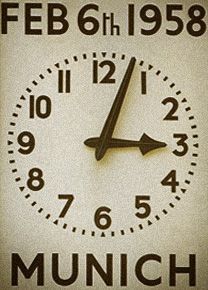
The legacy of Munich is not just the tragedy. It is the entire club itself.
Never forget.
Thanks for reading, and sorry for the delay. Been caught up with college. I’ll be back with more.
Sarma out.
 My Obsession with the Beautiful Game - An Analysis of Football By a Bored Teen